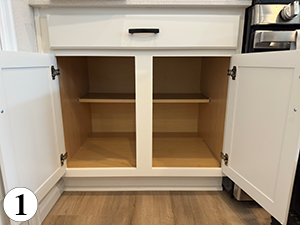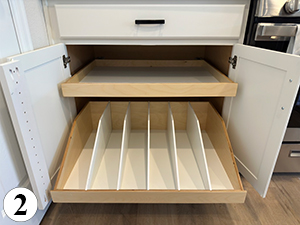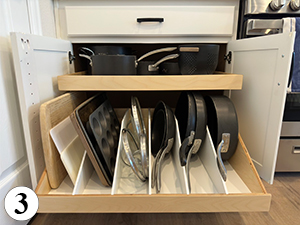
A Lazy Susan cabinet uses a rotating shelf so you can spin your stored items around to the front instead of reaching blindly into the back. It’s most useful in the two spots where cabinets waste the most space: the corner cabinet, where a big chunk of the interior is normally dead zone, and the pantry, where things get lost behind other things. Spin the shelf, and whatever was hiding in the back comes to you.
The problem it solves is specific. A corner base cabinet has a huge interior, but the opening is small and set at an angle, so most of that volume is unreachable without emptying the front. You end up storing a few things you can grab and letting the rest disappear. A rotating shelf turns that dead corner into usable, accessible storage — same footprint, a lot more of it actually in play.
Where a Lazy Susan earns its keep
Corner base cabinets. This is the classic use and the strongest one. Without a rotating shelf, a corner cabinet is mostly wasted. With one, you get full access to the whole interior by turning it.
Corner upper cabinets. Same dead-zone problem, higher up. A Lazy Susan up top keeps everyday dishes and glasses reachable instead of shoved into an angle you have to stand on a stool to see into.
Pantry cabinets. Spices, oils, cans, and jars are exactly the kind of small items that vanish behind a front row. A rotating shelf brings the back row forward so you stop buying a third bottle of something you already own twice.
Under-sink and blind corners are trickier — plumbing and odd angles limit what fits — but there are configurations built for those spots too.
Lazy Susan vs. pull-out shelves
People often weigh one against the other, so here’s the honest tradeoff.
A Lazy Susan shines in corners and for round or grouped items you rotate to reach — spices, sauces, cleaning supplies. It’s a rotation solution.
Pull-out shelves shine in standard straight cabinets where you want the whole shelf to come to you at once. They handle heavier and larger items well — pots, small appliances, stacks of bakeware — and they give you a flat, rectangular surface with no center post eating into the space.
Neither is “better.” They solve different geometry. A well-planned kitchen often uses a Lazy Susan in the corner cabinets and pull-out shelves everywhere else. If your frustration is a specific corner, a rotating shelf is likely the answer. If it’s reaching the back of a normal cabinet, pull-outs are the better fit.
A couple of practical notes before you buy
Weight matters. A rotating shelf loaded with cans and glass jars gets heavy, and cheap hardware sags or sticks over time. The mechanism and the build quality are what determine whether it still spins smoothly in five years.
Measure the real opening, not the cabinet. The usable diameter is limited by the door opening and any center hinge, not by how big the cabinet looks. This is where a stock unit often disappoints and a custom-fitted one doesn’t — it’s built to the actual cabinet.
Find out what fits your kitchen
Whether a Lazy Susan, pull-out shelves, or a mix makes the most sense depends on your specific cabinets. You can browse builds in the roll-out shelving gallery to see the options, or book a free in-home consultation. We’ll look at your corners and cabinets and tell you honestly which solution actually solves your problem — no reason to put a rotating shelf where a pull-out would work better.